A home security plan is a short written document that sets out the risks to your household, the measures that answer each one, who does what in an emergency, and when the plan is reviewed. You write it after a security assessment, and it turns the assessment’s findings into decisions the whole household can follow. This guide is for families, house managers and family offices who want a plan they can act on, whether they run it themselves or with a residential security team.
Security planning sits between two other jobs. The residential security assessment is the survey that finds the weak points. The seven essentials of home security are the measures you can choose from. The plan is what you write afterwards: which measures you will use, who is responsible, and how you will know it still works.
| Document | Question It Answers |
|---|---|
| Security assessment | What are the risks to this home and household? |
| Security measures | What could reduce each risk? |
| Security plan | What will we do, who does it, and when do we check it? |
Step 1: Set Out Who and What the Plan Protects
Start by listing what the plan is for. Write down:
- The people: every member of the household, regular guests, and staff who live in or work at the house.
- The places: each property the plan covers, including second homes and outbuildings.
- The assets: valuables, collections, vehicles, documents and data that would be costly to lose.
- The routines: school runs, regular travel, staff hours, deliveries and the times the house stands empty.
Keep this section factual and short. It is the reference point for every decision that follows.
Step 2: Record the Risks from Your Assessment
Copy the main findings of your security risk assessment into the plan, ranked by how likely and how serious each one is. A simple table works:
| Risk | Likelihood | Impact | Priority |
|---|---|---|---|
| Rear garden gate can be climbed | High | Medium | 1 |
| Cameras do not cover the side passage | Medium | Medium | 2 |
| House stands empty over school holidays | Medium | High | 1 |
| Former staff may still hold keys | Low | High | 2 |
Add your personal risk profile: how visible the family is in public and online, any threats received, and any travel to higher-risk places. A family in the public eye needs a different plan from one with valuables at home but a low profile.
Step 3: Choose the Measures for Each Risk
For each risk, decide what you will do about it, working from the outside in.
The Perimeter
Your boundary is the first line of defence. Fences and walls should be hard to climb, with nothing stacked against them; thorny planting such as pyracantha or hawthorn adds a natural barrier. Gates are often the weakest point: automated gates with an intercom give better control, and their mechanisms need a tamper-proof housing and backup power. Larger properties may add vehicle barriers or bollards. Motion sensors along the boundary give early warning, and need setting up carefully so wildlife does not cause false alarms.
Doors and Windows
Doors and windows are the most common way in. Standard doors often fail at the frame rather than the door itself, so fit solid doors with multi-point locks into reinforced frames with steel strike plates and long screws. Fit laminated glass and key-operated locks to accessible windows; where replacing a window is not possible, security film holds the glass together and slows an intruder. Patio doors need multi-point locks, anti-lift protection and alarm sensors.
Lighting and Cameras
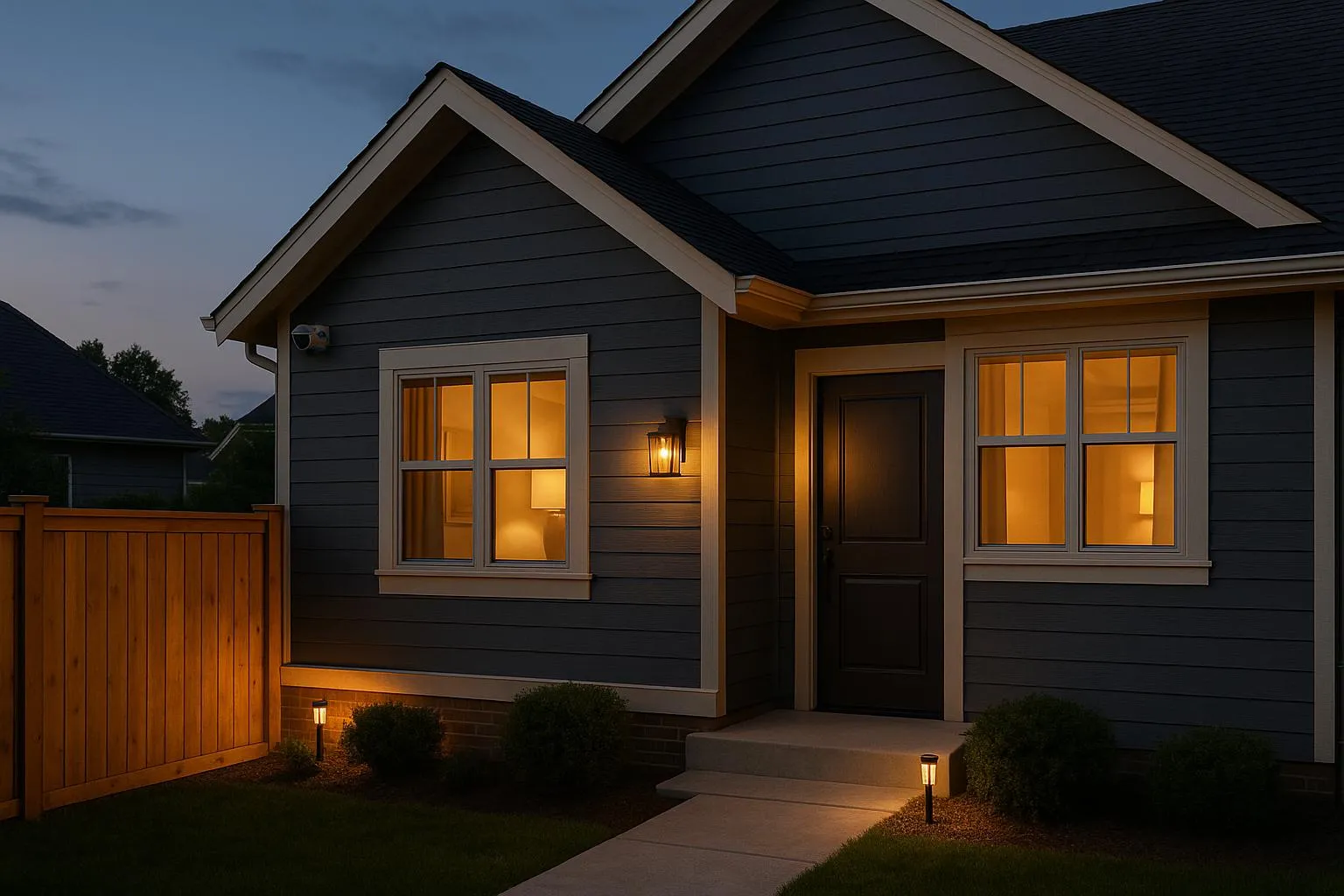
Motion-activated lighting removes hiding places on approaches and around entry points, and timers or smart lighting make an empty house look occupied. Cameras should cover every entrance with overlapping fields of view and give clear images at night. Store recordings for long enough to be useful, with a copy off site in case the recorder is taken, and choose systems that can tell people from animals so alerts are worth answering.
People and Specialist Measures
Higher-risk households may need more: residential security officers on site, a panic room, biometric access control, or close protection for travel. Family offices with several properties often coordinate one plan across all of them, so that standards and contacts are the same everywhere.
Write each decision into the plan next to the risk it answers, with a date for completion and the name of the person responsible.
Step 4: Assign Roles and Responsibilities
A plan without owners does not get done. Name:
- The plan owner: the person who keeps the plan current, usually a family member, the house manager or the family office.
- The day-to-day lead: whoever checks alarms, cameras and access each day, which may be a security team leader.
- Key holders: who holds keys, codes and access cards, and how they are recorded and recovered.
- The emergency lead: who takes charge in an incident and who calls the police.
Record how access is removed when staff or contractors leave, and how new staff are vetted before they start. Our staff vetting page sets out what that involves.
Step 5: Write the Emergency Procedures
Set out what everyone does if something goes wrong. Cover at least:
- Intrusion: how the alarm is raised, where the family goes (a safe room, or a purpose-built panic room if you have one), and who calls 999.
- Fire: escape routes from every floor, and where everyone meets outside.
- Medical emergency: where the first aid kit and defibrillator are, and who is trained.
- A threat or suspicious approach: who to tell and what to record.
Include a contact list with the emergency services, your security provider, the alarm monitoring centre, utility emergency lines and trusted contractors, and keep a printed copy in case the phones or the internet are down. Our guide to securing a home against invasion covers the family safety plan in more detail.
Step 6: Plan for the Seasons
Risk changes through the year, and a good plan says how security adjusts.
Darker Evenings
From autumn into winter, darkness falls during the hours when people come home, so arrivals and departures happen in the dark and a house shows lit or unlit windows for longer.
The pattern shows up in police data. Police in England and Wales recorded 10,900 home burglaries in November 2025, the highest monthly total in the year to June 2026 and 18% more than in September 2025 (ONS, Crime in England and Wales: Appendix tables). The Crime Survey for England and Wales also found that 70% of burglaries of homes in the year ending March 2025 happened in the evening or at night, between 6pm and 6am (ONS, Nature of crime: burglary).
Before the clocks go back:
- Check that security lighting covers every approach and entrance, and adjust timers to the earlier sunset.
- Check that cameras give clear images at night, and clean lenses and housings.
- Vary the times lights come on and off when the house is empty, so the pattern is not obvious.
- Ask the security team to vary patrol times as the evenings draw in.
Empty Homes over Holidays
School holidays, half-term and the Christmas break leave houses empty at predictable times. An empty house gives itself away through post piling up, lights on a fixed timer and no cars coming and going. In the plan:
- Arrange for post and deliveries to be collected or held.
- Use varied lighting schedules and keep the house looking lived in.
- Decide who checks the property and how often, or arrange guarding or property guardianship for longer absences.
- Keep travel plans off social media until the family is home.
- If the family itself needs protection while it travels, plan close protection for the trip alongside cover for the empty house.
Contractors and Seasonal Staff
Holidays are often when maintenance and building work happen, and when temporary staff are hired. Each new person with access is a potential weakness. Vet them as you would permanent staff, log who comes and goes, supervise access, and remove it when the work ends.
Weather
Autumn and winter storms damage fences, move cameras and knock out lighting, and heavy rain and wind cause false alarms. Inspect the boundary and the cameras after severe weather and repair damage quickly, before it becomes a way in.
Step 7: Maintain, Test and Review
Even the best systems fail without upkeep. Put the checks into the plan:
| How Often | What to Check |
|---|---|
| Weekly | Alarm and camera status, batteries, recordings |
| Monthly | Test alarms and panic buttons, review access logs |
| Quarterly | Update the contact list, check locks and gates, run a drill |
| Annually | Professional service of every system, full review of the plan |
Install software updates promptly, because manufacturers release them to close security gaps. Keep a log of faults and repairs, so recurring problems stand out.
Review the whole plan at least once a year, and straight away after an incident, a move, building work, a change of staff or a change in the family’s public profile.
Working with the Community
Neighbours are part of a home’s security. A neighbourhood watch scheme, a residents’ group or a shared messaging channel helps people spot and report unusual activity, and the local neighbourhood policing team can tell you about recent incidents and trends. Note in the plan who you share information with.
A Simple Template for Your Plan
You can set out a home security plan under these headings. Keep each one short, and put the detail in tables and lists.
- Scope: the people, properties, assets and routines the plan covers.
- Risks: the findings of the assessment, ranked by priority, with the date of the assessment.
- Measures: what you will do about each risk, who is responsible, and by when.
- Roles: the plan owner, the day-to-day lead, key holders and the emergency lead.
- Access: how keys, codes and cards are issued, recorded and recovered, and how staff and contractors are vetted.
- Emergency procedures: what everyone does in an intrusion, a fire or a medical emergency, with escape routes and meeting points.
- Contacts: emergency services, security provider, monitoring centre, utilities and contractors.
- Seasonal adjustments: lighting, empty periods, contractors and weather checks.
- Maintenance and review: the testing schedule, and the date of the next full review.
Mark the plan confidential, keep it to the people who need it, and store a printed copy somewhere secure but reachable. Anyone who holds it should know what to do if a copy is lost.
FAQs
What is security planning?
Security planning is the process of deciding how to protect a home and household, then writing it down. It starts from an assessment of the risks, chooses the measures that answer each one, assigns people to carry them out, sets out what happens in an emergency, and fixes dates for review. The result is a plan that the whole household and its staff can follow.
What should a home security plan include?
A home security plan should include who and what it protects, the risks found in the assessment ranked by priority, the measures chosen for each risk, named owners and deadlines, emergency procedures with a contact list, seasonal adjustments, and a schedule for maintenance and review. Keep it short enough that people will actually read it, and store a printed copy somewhere safe.
How often should a security plan be reviewed?
Review it fully at least once a year, and straight away after an incident, a move or building work, a change of household staff, or a change in the family’s public profile. Check the seasonal parts before autumn and before long holidays. Shorter checks, such as testing alarms and updating contact lists, belong on a monthly or quarterly schedule within the plan.
What is the difference between a security assessment and a security plan?
The assessment is the survey: a specialist examines the home, grounds and routines and reports the weaknesses. The plan comes afterwards and is the household’s own document: it records which recommendations you will carry out, who is responsible, what happens in an emergency and when everything is checked. One finds the problems; the other sets out how you will manage them.
What to Do Next
If you would like help writing or running a security plan for your home, talk to us about residential security.